
Monday Musings – It’s Never Just Hair
Today’s post is a bit of a life update on something I’ve been struggling with again behind the scenes.
Thinning hair and hair loss are brutal on a woman’s self-esteem. We know full well our worth isn’t tied to our hair, yet we still feel that sickening sink in our stomach when we look at the shower drain. Have you ever caught yourself staring at your scalp in the bathroom mirror under direct light, just trying to figure out if it’s worse today than it was last month? I don’t know about you, but being told “it’s only hair” has never once made the scalp showing through any less unsettling. It certainly doesn’t make the loss any easier to carry.
My own battle with thinning hair has been going on for a decade now. Over the years, I’ve tried just about everything: topical minoxidil, GrandeHAIR serum (do I know if it works? I can’t say for sure since I’m doing so much else, but it’s easy enough and I’m not stopping now), and eventually oral minoxidil prescribed by my dermatologist. That oral minoxidil made a massive difference for a long time. Later, we added finasteride. Here are some other things that help.
Until recently, when my latest bout of shedding decided to go on longer than usual. My female pattern hair loss shows up mostly on the top and sides, leaving the back thick and lush. It’s a bit of cruel irony that isn’t particularly helpful when looking in the mirror. I’d been trying to grow my hair into a single length, but the front got so thin I finally threw in the towel and had my bangs cut back in.
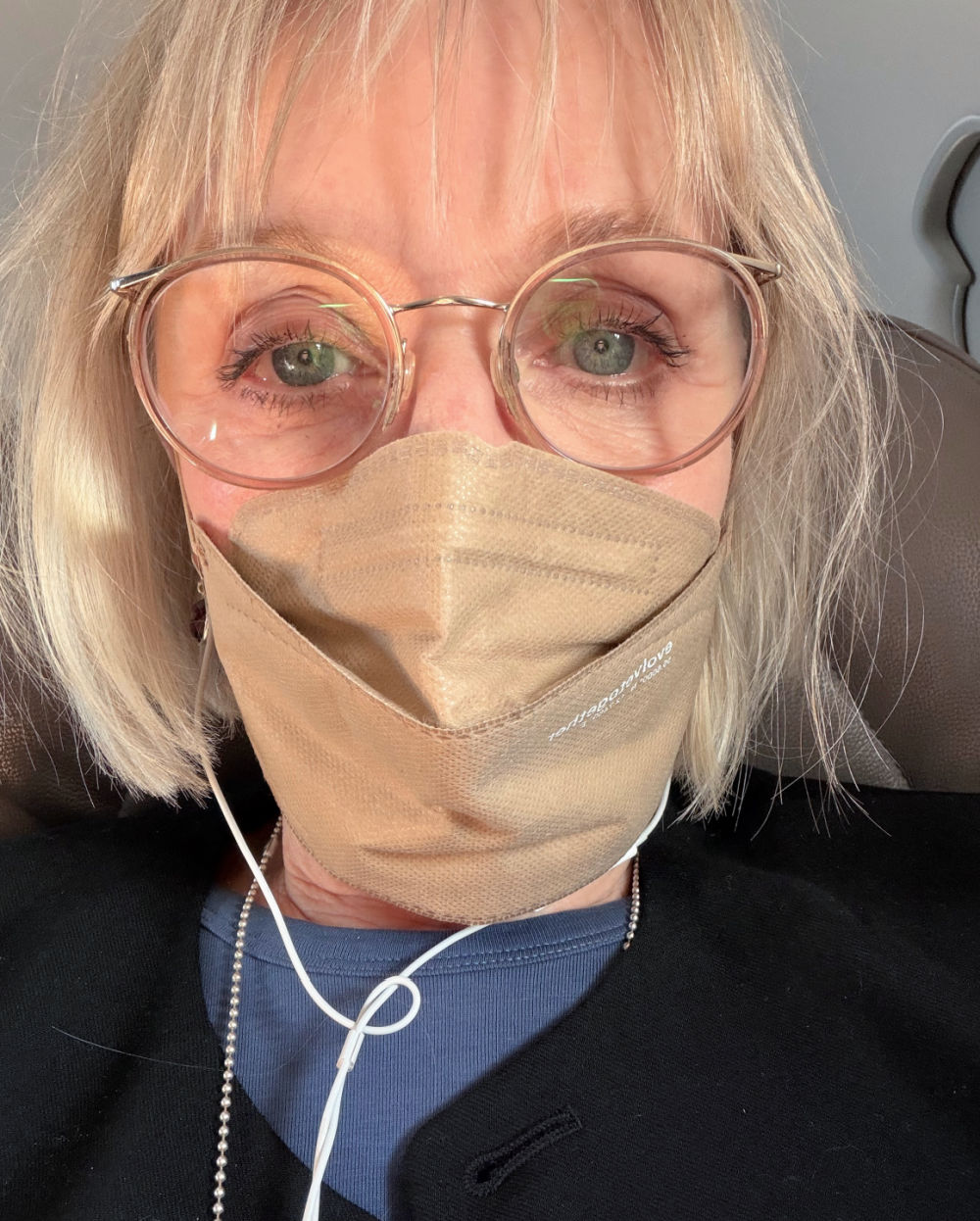
I snapped one quick picture on the plane home to California, which might be the only photo you see of me for several days because I also picked this week to start another round of skin cancer cream, and my nose and cheeks currently look like I stuck my face in a bowl of spaghetti sauce.
A few weeks ago, out of sheer frustration, I brought up PRP (platelet-rich plasma) with my dermatologist. I didn’t choose it on a whim. There’s real scientific research behind PRP for female pattern hair loss showing that concentrated growth factors can increase hair density and shaft thickness. Because my dermatologist recommended it as a solid next step alongside my medications, I decided to try it.
The theory is straightforward… they draw your blood, spin it in a centrifuge to separate the plasma, and inject it directly into the thinning spots. It works best where follicles are struggling but still active, rather than areas that have been smooth for years. For scalp treatment targeting the top and sides, they place injections about half an inch apart in a tight grid across the head.
What nobody adequately prepares you for is that they do not numb your scalp first. At least mine wasn’t… and let me tell you, it’s excruciating. I sat breathing deeply, white-knuckling the chair, just trying not to ask them to stop. I went home with a throbbing headache that lasted for days, alongside a bruised, swollen scalp. I swore I’d never do it again, but I scheduled the next two monthly appointments.
If you’ve ever considered this or a dermatologist has mentioned it, a couple of practical things are worth knowing. PRP is strictly out of pocket because insurance treats it as cosmetic. You also have to avoid anti-inflammatory medications like Advil or Aleve for a few days before and after, because that temporary inflammatory response is actually what triggers the healing process.
Because PRP works on the biological schedule of our hair cycle, patience is required… and patience has never been my strong suit. Expecting overnight miracles only leads to frustration, but knowing the realistic timeline keeps me grounded:
- Month 1: Everything happens under the hood. Growth factors wake up dormant follicles and boost circulation, though I won’t see a thing in the mirror yet.
- Month 2: The first real win isn’t new growth; it’s reduced shedding. I should start seeing fewer strands in the brush and shower.
- Months 3–4: Fine new hairs begin pushing through, and existing strands start feeling a bit sturdier under my fingers.
- Months 6–12: Peak density arrives. Thinning areas look visibly fuller, and texture improves.
To keep whatever progress I make, PRP requires an initial series of 3 to 4 monthly sessions, followed by a maintenance shot every 6 to 12 months. I chose 3 sessions and am praying it helps.
One of the meaner tricks of hair loss is how confusing it can be to figure out what’s actually causing it. Extreme stress can trigger a temporary shedding phase known as telogen effluvium, but that’s very different from long-term thinning, which is usually tied to genetics, shifting hormones, thyroid imbalances, or nutritional deficiencies. Being told to “just relax” is completely useless when the real issue is biological, and the evidence is sitting right there in your hairbrush.
Too often, when women bring up hair loss to a doctor, we get dismissed with a wave of the hand, a suggestion to reduce stress, or a polite “it just happens as we age.” If your dermatologist brushes you off, don’t just accept it. Demand to be taken seriously, ask for tests to rule out underlying issues, or find another doctor who will actually listen and help you explore real options.
Hair loss isn’t trivial, and acknowledging that doesn’t make us vain. It just makes us practical women dealing with a frustrating, painful reality, doing what we can to advocate for ourselves and tackle it head-on together. We spend so much time carrying this worry in silence. If you’ve been through something similar, or if you’re right in the middle of it like I am, I’d love for you to share your story in the comments.